Global 5G Healthcare Market: Poised for Explosive Growth Fueled by Remote Care and Innovation
- VynZ Research

- Jun 6, 2024
- 5 min read
Introduction
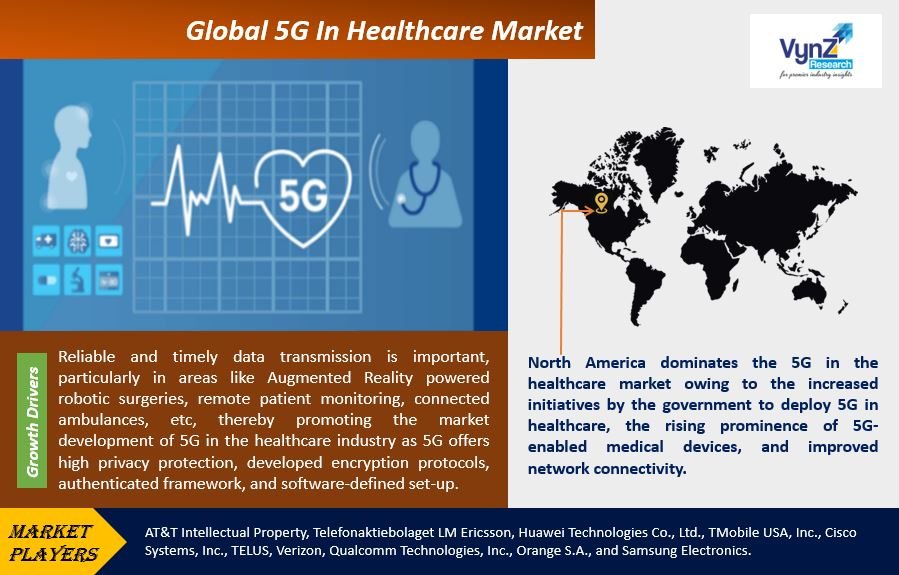
The global 5G in healthcare market is expected to grow from USD 50.1 billion in 2023 to USD 470.71 billion by 2030. It is predicted to grow at a CAGR of 33.45% during the forecast period. From remote patient monitoring to advanced surgical procedures, the potential applications of 5G in healthcare are vast and varied. This article delves into the key drivers behind the explosive growth of the 5G healthcare market, explores current trends, and offers a glimpse into the future of this dynamic field.
Enhanced Remote Patient Monitoring
One of the most promising applications of 5G in healthcare is enhanced remote patient monitoring. Imagine being able to monitor patients with chronic conditions like diabetes or heart disease in real-time, regardless of their location. 5G's high-speed connectivity and minimal latency enable healthcare providers to receive real-time data from wearable devices, allowing for timely interventions and better management of chronic conditions. This not only improves the quality of patient care but also reduces hospital readmissions and overall healthcare costs.
Rise of Telehealth and Telemedicine
Telehealth and telemedicine have gained significant traction in recent years, and 5G is set to propel these services to new heights. Virtual consultations have become a lifeline for many, especially in remote or underserved areas. With 5G, these consultations can be conducted in high definition, providing clear video and audio quality. Moreover, the ability to transmit medical data swiftly and securely facilitates remote diagnostics, ensuring that patients receive accurate and timely care. This expanded access to specialists, regardless of geographic barriers, represents a significant leap forward in healthcare accessibility.
Revolutionizing Surgery with AR/VR
The integration of augmented reality (AR) and virtual reality (VR) into surgical procedures is another groundbreaking development facilitated by 5G technology. Surgeons can now receive real-time guidance through AR overlays, enhancing precision and reducing the risk of errors. Additionally, VR allows for remote surgeries, where experts can perform complex operations from different locations, leveraging 5G's robust connectivity. These innovations not only improve surgical outcomes but also democratize access to advanced medical procedures.
Connected Ambulances for Improved Emergency Care
5G technology is also transforming emergency care by turning ambulances into connected mobile intensive care units (ICUs). Emergency medical technicians (EMTs) can transmit vital patient data, such as ECGs and vital signs, to hospitals in real-time. This enables hospital staff to prepare necessary resources and medical interventions before the patient's arrival, significantly improving the chances of positive outcomes. The ability to provide such advanced care in transit is a game-changer for emergency medical services.
Market Size and Growth Projections
The global 5G healthcare market is on a rapid growth trajectory. According to Vynz Research, the market size is expected to expand significantly in the coming years. Factors such as the increasing adoption of 5G technologies in healthcare settings, the rise of telehealth, and the need for efficient remote patient monitoring systems are driving this growth. As more healthcare providers recognize the benefits of 5G, investments in this technology are set to soar, further fueling market expansion.
Capitalizing on the Opportunities
To fully capitalize on the opportunities presented by 5G in healthcare, collaboration among various stakeholders is crucial. Healthcare providers need to invest in 5G infrastructure and adopt innovative solutions that leverage this technology. Technology companies can contribute by developing cutting-edge applications tailored for healthcare settings. Policymakers also play a vital role in creating a supportive regulatory environment that addresses data privacy concerns and facilitates the seamless integration of 5G technologies.
Challenges and Solutions
Despite its immense potential, the 5G healthcare market faces several challenges. Data privacy and security are paramount concerns, given the sensitive nature of health information. Robust encryption protocols and stringent regulations are necessary to protect patient data. Additionally, the infrastructure required to support 5G connectivity can be expensive and complex to implement. Addressing these challenges requires concerted efforts from all stakeholders, including governments, healthcare providers, and technology companies.
Case Studies and Real-World Examples
Several real-world examples illustrate the successful implementation of 5G in healthcare. For instance, a hospital in China used 5G technology to perform a remote brain surgery, with a surgeon operating from a distance of nearly 3,000 kilometers. The procedure was a success, showcasing the potential of 5G in enabling remote surgical interventions. Another example is the use of 5G-enabled wearable devices for monitoring patients with chronic conditions in real-time, leading to improved management and better health outcomes.
Future Trends and Innovations
The future of 5G in healthcare looks promising, with numerous emerging trends and innovations on the horizon. From AI-driven diagnostics to robotic surgeries, 5G will play a pivotal role in advancing these technologies. Wearable devices equipped with 5G connectivity will become more sophisticated, providing continuous health monitoring and early detection of potential issues. The integration of blockchain with 5G can enhance data security and interoperability, further revolutionizing healthcare delivery.
Global Impact and Accessibility
While developed countries are at the forefront of adopting 5G in healthcare, efforts are being made to ensure that developing nations also benefit from this technology. International collaborations and partnerships are crucial in bridging the digital divide and making advanced healthcare accessible to all. By investing in 5G infrastructure and training healthcare professionals, developing countries can harness the power of 5G to improve healthcare outcomes and reduce disparities.
Economic Implications
The economic implications of the 5G healthcare market are profound. A cost-benefit analysis reveals that the initial investment in 5G infrastructure is outweighed by the long-term benefits, including reduced healthcare costs, improved patient outcomes, and increased efficiency. Furthermore, the 5G healthcare market presents lucrative investment opportunities for businesses and investors, driving economic growth and innovation in the healthcare sector.
Regulatory and Policy Considerations
The successful implementation of 5G in healthcare requires a supportive regulatory and policy framework. Current regulations need to be updated to accommodate the unique requirements of 5G technology, particularly in terms of data privacy and security. Policymakers should focus on creating standards that ensure compliance while fostering innovation. Collaboration between regulatory bodies, healthcare providers, and technology companies is essential to develop policies that promote the safe and effective use of 5G in healthcare.
Patient and Provider Perspectives
The perspectives of patients and healthcare providers are crucial in understanding the impact of 5G in healthcare. Healthcare providers report improved efficiency and patient outcomes with the use of 5G technologies. Patients, on the other hand
About Us
Global market research company, VynZ Research provides research, analytics, and consulting services for business plans. We provide specialized market research reports based on information that was predicted and estimated by industry professionals and experts. In addition to industry experts, the top-down and bottom-up approaches, data triangulation, and other techniques enable the market research leader to validate the data and deliver a major market study.
Contact Us:
Address: H.O - 9591 Fontainebleau Blvd. 617 Miami Florida 33172 U.S.A
Phone: +91 9960 288 381
Toll Free:1 888 253 3960
Email: marketing@vynzresearch.com
Website: www.vynzresearch.com


Comments